.png)


The Only Baby Toys You Need for the First 6 Months

When you’re pregnant or a new mom, it can feel like your baby needs every toy in the store.
Everywhere you look, there’s something claiming to boost development, spark early learning, or improve milestones. But here’s the truth most people won’t tell you: babies learn best from a few simple, development-focused toys, and a whole lot of connection with you.
Your baby learns primarily from the people caring for them. Talking, holding, feeding, smiling, and interacting are the foundation of their development. Those little moments of connection help your baby feel safe enough to begin exploring their world.
Toys can support learning and give structure to play, but they are not the main event. You are.
And the best part? Great toys don’t have to be fancy, expensive, or high-tech. In fact, some of my daughter's favorite “toys” have been everyday household items: ceiling fans, measuring cups, plastic water bottles (clean and supervised, of course). If you know, you know.
But when you do want toys that genuinely support development and make daily life smoother, it helps to understand what babies actually need in the first six months and how to choose toys that support those early milestones without overwhelming your home (or your baby’s senses).
Let’s break it down in a simple, realistic way.
Understanding Baby Play in the First Six Months

Walking through the toy aisle as a new parent can feel like sensory overload.
Everything looks cute, colorful, and “perfect” for development, but the options are endless.
You might find yourself wondering:
Do I really need all of this?
Which toys are actually helpful?
How do I avoid turning my house into a toy store?
In the beginning, it’s even more confusing because your baby can’t reach, hold, or even fully focus on most objects. So much of the first three months is sleep, feeding, and diaper changes; so where do toys even fit in?
Here’s the secret: babies don’t need a lot.
What they need is predictable, simple stimulation paired with human connection. They learn through repetition, movement, sound, and your facial expressions. Their vision, strength, coordination, and curiosity gradually expand, and toys simply give them more ways to explore.
Simple toys (the right toys) can:
Encourage reaching and grabbing
Support tummy time
Strengthen hand-eye coordination
Offer sensory exploration
Build early problem-solving skills
Give babies something safe to chew
Help soothe fussiness
Foster bonding moments with you
Below are the only toys I’ve ever needed for the newborn-to-six-month stage: the ones that support development without overwhelming you or your home.
1. Activity Mat With Dangling Toys
If I had to pick one baby toy to keep for the first six months, this would be it. An activity mat grows with your baby and supports so many important milestones.
Yes, they come in different patterns, colors, and styles, soft pastels, bright primary colors, mats with music, mats without, even neutral wooden ones if you love a more aesthetic home.
But the mat itself isn’t the magic. The dangling toys are.
Here’s why activity mats matter:
In the beginning, the toys give your baby something interesting to look at.
As their vision sharpens, they start tracking the toys with their eyes.
As they gain strength, they begin reaching, swatting, and eventually grabbing.
The placement of toys can encourage rolling, a huge milestone.
It gives your baby a safe, familiar space to practice motor skills.
And an added bonus for parents: it’s a safe place to set your baby down if you need to answer a text, wash your hands, or grab a snack.
It also creates natural bonding moments like lying next to them, talking about the toys, singing, or gently guiding their hands.
This is the one I have (Baby Einstein), but I know this Fisher Price one is a popular option as well.
2. A Quality Teether

Teething toys are essential… even before teeth arrive.
Babies explore the world with their mouths and it’s how they learn texture, temperature, shape, and sensation. Teethers also help relieve gum pressure as those first teeth begin to shift under the surface (yes, even at three months).
With so many options, it can be hard to know what to pick. There are chilled teethers, ring teethers, mitt teethers, silicone beads, ridged toys; it’s a lot.
Here’s what actually matters:
Choose silicone or another safe, chew-friendly material.
Look for something easy for small hands to grip.
Pick a teether with texture: bumps, ridges, or patterns.
Avoid anything overly complicated or heavy.
Babies often prefer different teethers at different stages. A simple ring might be perfect in early months, and later they may want something longer or differently textured. That’s normal and their needs change as their mouth develops.
Here are a few great ones we have and love:
Fruit teether (This one has hands down been a favorite)
3. Stacking Rings (Rings on a Stick)
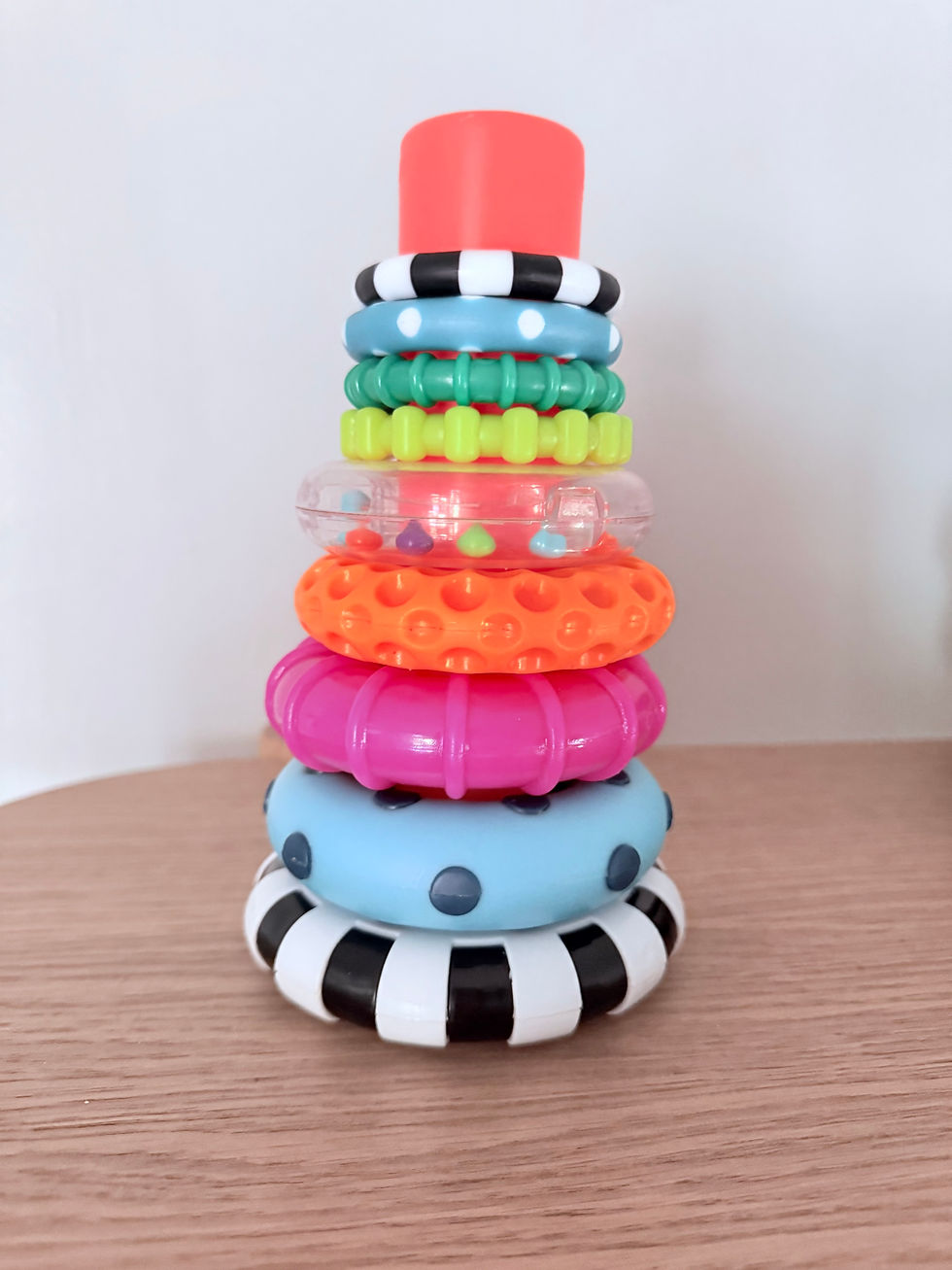
This one is so classic it’s easy to overlook. It seems simple, maybe too simple, until you realize how much developmental potential is packed into this toy.
Stacking rings support:
Early grabbing
Transferring objects hand-to-hand
Visual tracking
Color awareness
Problem solving
Fine motor skills
Hand-eye coordination
Babies love trying to grip the rings, shake them, mouth them, and eventually try to pull them off the pole. Many versions now include different textures, materials, and even rattles inside some of the rings for extra sensory feedback. The one pictured you can find here, but there are many others available, including rocking styles, silicone options for teething relief, and soft fabric designs.
Here’s the best part: this is a toy that lasts for years. Toddlers use it to work on sequencing, size order, and imaginative play.
It’s simple, long-lasting, and surprisingly engaging.
4. A Small Toy With Gentle Music or Songs

I know, sound toys can be controversial. Some parents love them, some avoid them completely. And honestly, many sound toys are overstimulating. The lights are too bright, the sounds too loud, the movements too jarring.
But a simple, gentle sound toy can actually be incredibly soothing and helpful for newborns. And for my four girls, a soft musical toy has been one of the easiest ways to calm them.
Look for:
Soft lullabies
Classical music
Volume options
Slow, predictable rhythms
No disco lights
No spinning or chaotic movement
If it feels like too much for you, it’s probably too much for your baby.
Think of this type of toy as a bonus tool: something that gives your baby comforting sensory input during diaper changes, tummy time, or car rides.
Here are some well loved options we have tried:
5. Crinkle Books, Rattles, and Sound-Making Toys (Without Lights)

These are often the first toys babies genuinely interact with. They provide instant, natural feedback:
Crinkle = sound when squeezed
Rattle = noise when shaken
Cloth books = texture when touched
These toys help develop cause-and-effect understanding like “When I move, something happens.” That’s a big cognitive leap.
They also support:
Grasping
Strengthening hands and fingers
Sensory exploration
Early play independence
Eye tracking
Crinkle books in particular are great for tummy time because they encourage babies to look forward, reach, and stay engaged. Rattles can also be used by you to practice tracking by gently moving the rattle side to side while your baby follows the sound.
Simple? Yes. Effective? Very.
Here are some great options:
6. Lightweight Grabbing Toys

As babies grow, they want to grab everything. But many baby toys are actually too heavy or bulky for young infants to hold on their own.
That’s why lightweight gripping toys are so important. Think:
Soft sensory balls
Easy-to-hold fabric toys
O-ball style open-grid balls
Soft books
Small silicone toys
Bath books
Lightweight plastic rings
These toys help babies practice:
Grasping
Shaking
Releasing
Passing objects from hand to hand
Bringing objects to their mouth safely
Having a few of these around makes playtime smoother, calmer, and more developmentally appropriate for those first attempts at grabbing.
These have been our favorites:
Why You Don’t Need a House Full of Toys
Babies thrive on simple, predictable, connected interactions. Most of the toys marketed for newborns are:
Overstimulating
Too advanced
Redundant
Unnecessary
And honestly? Babies overlap their play needs more than people realize.
For example:
Many rattles double as teethers.
Many crinkle toys double as early books.
Many stacking toys include rings with rattles or textures.
Many activity mats include removable toys that function on their own.
You don’t need a lot, especially not in the early months.
Your voice, your face, your touch, and your presence are the greatest “toys” your baby will ever have.
How to Use Toys Intentionally
Toys aren’t meant to entertain babies constantly. They’re meant to support their development within short windows of play. Here’s how to make the most of the toys you have:
Rotate toys weekly: This keeps your baby engaged and helps prevent overstimulation. Put out 3–5 toys at a time and change them out regularly.
Set up play with purpose: During floor time, offer a few toys that encourage reaching, tracking, mouthing, or sensory exploration.
Pair toys with bonding: Sing while shaking a rattle. Read a crinkle book out loud. Narrate what your baby sees or feels. Playtime is connection time.
Follow your baby’s cues: If they look away, squirm, close their eyes, or cry, they might be overstimulated or tired. Offer a break.
Let's Wrap This Up!
You don’t need a house overflowing with toys to support your baby’s development. What your baby needs most is simple, intentional tools paired with your love, attention, and presence. Minimal toys help:
✔️Calm overstimulation
✔️Reduce clutter
✔️Strengthen connection
✔️Support natural developmental stages
✔️Make playtime peaceful and purposeful
Remember: Your baby will always choose you over any toy. And that’s exactly how it should be.
✨Want More Stress-Free, Confidence-Boosting Support for Baby’s First Year?
Join my course Surviving the First Year: your roadmap to simple routines, realistic development support, bonding, and feeling like a confident new mom.
👇 Click here to enroll.


Comments